

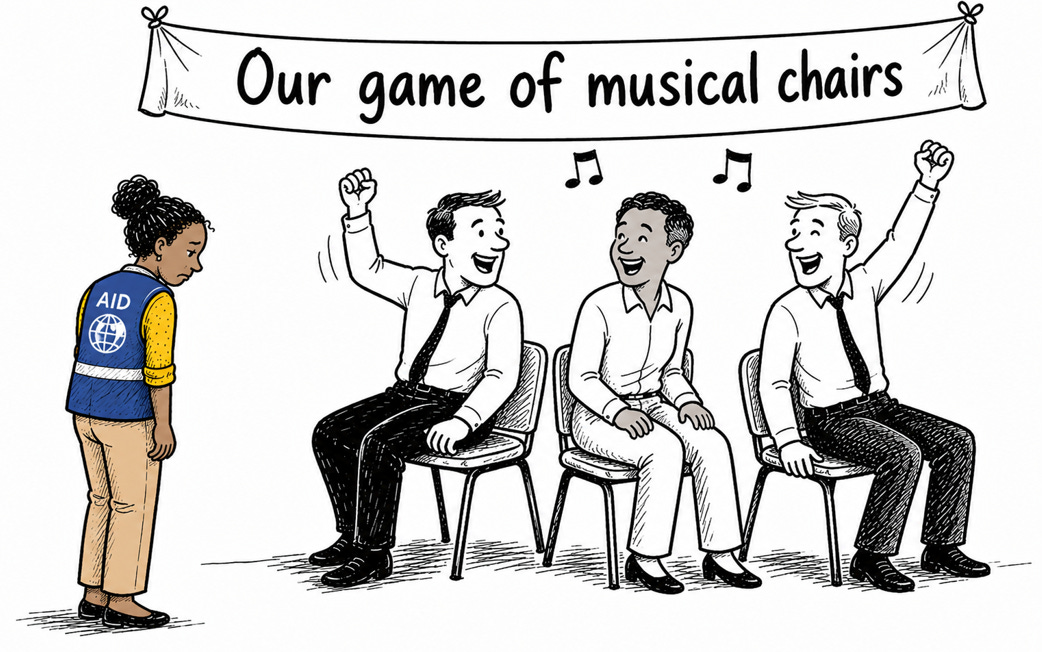
Years ago a colleague described our sector to me with a simple analogy, and I have never been able to unsee it:
“If all of us who work for the large international NGOs stood up at once, and our organizations each moved one step to the left, we could sit back down at the next desk and go about our day without noticing anything had changed.”
The same work would be in front of us. Fundraising. Proposal writing. Contract vetting. Compliance returns. Donor reports. Only the pictures on the wall would be different, and not by much. The child who was on the wall became a refugee, and the refugee became a woman entrepreneur, but the desk, the role, the function, the person sitting at it, all of it was interchangeable.
(Apologies for mixing metaphors)
This is not an insult. It is an accurate description of what twenty-five years of government grant funding did to us. We all bid for the same grants. We answered the same RFPs, under the same compliance rules, against the same minimum standards, citing the same best practices, increasingly with the same staff moving freely between us, because a logistics director at one agency is a logistics director at the next and everyone knows it. Headquarters structures converged. Regional offices converged. National offices, field offices, the whole vertical converged, because the funding regime selected for a coherent shape and then ran the filter for a quarter of a century. We did not set out to become identical. We were finely milled into it, one RFP at a time, until the org chart of any one of us could be laid over any other and the lines would match. I mean it. Match exactly.
And once you see that, you can see the opportunity it creates, because the people now running these organizations have certainly seen it. If we look the same, operate the same, staff the same, and do the same work in the same structure, then the redundancy is not hidden. It is the whole system. You could take a single field office, add one logo to the door, then add another, and the work would not change because the work was already a mirror image. The strategic insight writes itself. If we are this alike, why don’t we just…
That is the sentence the Impact Alliance finishes.
II.
In June 2026, three of the largest humanitarian organizations in the world finished it for me. Mercy Corps, CARE, and Save the Children announced the Impact Alliance, a new collaboration to share procurement, support services, data systems, and field operations. The case they made was the one I happen to agree with. The money is gone and it is not coming back on the old terms. Real official development assistance fell by nearly a third in two years. The architecture built over twenty-five years of government grants cannot be funded at the level it was built to require. Something has to change.
So far we are in agreement. It is the next step where we part.
Read the structure and not the name, because the name is doing work the structure cannot honor. “Impact” promises a pathway to more impact. There is none in this design. “Alliance” is the gentler word for consolidation. What the Impact Alliance actually is, stated without the tagline, is a rational and well-run plan by three large organizations to survive on a declining topline by sharing the cost of being three large organizations. It is not a proposal for what comes after the architecture that just failed. It is a proposal for how to keep that architecture standing for less money. From inside their boardrooms it is the responsible thing to do. I want to be fair about that, because the danger in what follows is not that these are foolish people making a foolish choice. The danger is the opposite. They are capable people making the locally rational choice, and the structure they have built routes the cost of that rationality exactly where the homogenization I just described said it would.
I am not writing this from outside. I ran two large international NGOs. I have sat in the chair these three CEOs are sitting in, with the same board behind me asking the same question: how do we survive when the money has gone and the structure is this expensive and this spread out. I know the arithmetic in my body. Put me back in that chair tomorrow, with a fiduciary duty to an institution, a payroll to meet, and a board that wants a plan by the next meeting, and I would build something very close to the Impact Alliance. I would call it the responsible thing. I might even believe it. That is not a confession meant to soften what follows. It is the reason what follows is worth saying. The problem with the Alliance is not that the wrong people made it, the careless or the cynical. It is that the right people, doing the responsible thing, with real fiduciary care, arrive exactly here. The trap is not in them. It is in the structure that makes this the rational move, and I helped build that structure. I am not judging it from across the room. I am judging it from inside it, as someone who would do the same thing under the same lights and thinks it is still the wrong answer. Or perhaps better put, not enough of an answer.
So watch where it begins. If every layer of these organizations is interchangeable, headquarters with headquarters, region with region, field with field, then a plan to remove redundancy could begin anywhere. It could begin at the top for example. Watch which layer is asked to consolidate and which layer is left exactly as it was. That is the whole story of the Impact Alliance, and you can read it in the first job they posted.
III.
The first role the Impact Alliance posted was not a designer. It was a lawyer.
The job is to build the Alliance’s legal structure, its governance, its dispute-resolution mechanism, and the data-sharing framework that lets three separate organizations pool what they pool. It is a serious role and a necessary one, and that is the point. You can tell what kind of project something is by the first capability it reaches for. A redesign reaches first for a designer, someone whose job is to ask what the thing should become. A consolidation reaches first for a lawyer, because sharing contracts, systems, and data across three US entities and a set of international affiliates is, before it is anything else, a legal problem. The first hire is not a detail. It is the project naming itself out loud.
And notice what the lawyer is there to protect. Not the mission. The mission does not need a dispute-resolution mechanism. What needs careful legal work is the boundary between three institutions that intend to share their costs while remaining three institutions. The lawyer exists to make consolidation safe for the entities consolidating. That is a reasonable thing to want if you are one of those entities. It is also a description of the ambition. The first dollar of design spend went to securing the perimeter of the existing organizations, not to imagining anything past them.
There is a second early role worth noting, because it points the same direction from the other end. It is a technical lead for an artificial intelligence pilot, which I will come to, because what they have chosen to build with the most powerful new tool available to them tells you as much as the lawyer does. For now hold only this. Of the first capabilities the Alliance went looking for, the one at the top was the one that keeps the three organizations intact while they share the costs. Localization, the word that does the heavy lifting in the announcement, appears last in the description of the work, beneath procurement and support services. I assume the order is not an accident. The order seems a reflection of priority, written down.
IV.
Now watch which layer is asked to consolidate.
Every large international NGO is built in two parts. There is a concentrated layer and a distributed one. The concentrated layer is headquarters, the national fundraising entities in the donor capitals, the regional offices with their vice-president-level heads, and the boards. It is expensive, it is senior, and across these three organizations it is almost perfectly duplicated. Three headquarters doing the same headquarters work. Three fundraising machines courting overlapping donors. Three sets of regional leadership. If the homogenization I opened with is real, it is reflected here perfectly, because this is the layer furthest from the particular country and closest to the funding regime that milled all three into the same shape.
It is also the most expensive single layer. In my experience something like 40 to 50% of total expense.
Then there is the distributed layer. National offices, field offices, and beneath them the local organizations that do the actual implementing. This layer has always flexed. It grows when a grant is won and contracts when a grant closes, and that churn is so normal that no one inside the sector experiences it as a crisis (unless it’s your job). It is also where the local staff are. In my experience, across thirty years and more than eighty countries, the field layer of these organizations is upward of ninety percent national staff, people who are citizens of the countries they work in, and below them the implementing partners are local entities entirely. The work, the actual work, has always been overwhelmingly local. The northern, concentrated layer has never been where the work happened. It has been where the work was raised, contracted, reported, and explained.
A plan to remove redundancy could begin in either layer. The redundancy is larger and more defensible to cut in the first. Three headquarters is a genuine triplication. A field office in a country where the work is actually happening is not redundant with anything, it is the work. So a design serious about efficiency, rather than about survival, would look hardest at the top.
The Impact Alliance looks at the bottom. What it consolidates is procurement, support services, back-office systems, and field operations. What it leaves untouched is three headquarters, three fundraising entities, three boards, and the regional leadership. The most redundant layer in the entire system, the one place where the interchangeability is closest to absolute, is the one layer the Alliance does not put on the table. And the reason is not mysterious. The people who designed the Alliance are that layer. A structure does not consolidate the seats of the people who built it.
This is the danger, the cost of survival is being routed away from the layer that is most expensive and onto the layer that is not. The center is held. The field absorbs. The local layer.
I say this gently, because words matter. We do need to be careful about framing or at least implying that something is being done to honor the local, the people at the coal face, in the countries we are “helping”. That in fact hits them hardest. It feels vaguely Orwellian. And we should be upfront. A moment offering us a chance for deep structural redesign has arrived. A clean sheet of paper, the first in twenty-five years, opened by a funding collapse severe enough to force three competitors into the same room. And on that clean sheet, the redesign exempted the one layer that was always the more powerful and chose to seek its saving elsewhere.
The point was never that the field flexes. It always has. The point is what they chose to protect when, for once, they could have chosen anything.
It may be argued that give credit where it’s due, the Alliance may reduce transaction costs for local implementers. The small organization that used to manage three separate contracts, three reporting formats, three compliance regimes, now manages one. The small NGO in Mogadishu that used to implement for all three of those NGOs now only has to deal with one umbrella entity. But I wonder where the saving goes, because a saving is only a gain for the person who keeps it. Nothing in the structure routes that saving back down to the implementer as a higher share of overhead or a seat at the table, because there is no local actor in the room with the standing to ask for it. And consider what the implementer has lost on the other side of the ledger. They used to have three buyers. Competition, however thin, was leverage. Now they have one umbrella, one buyer, one set of terms, take it or leave it. One report instead of three is simpler. It is also riskier, and simplicity is the word that makes it sound more palatable.
It would also not be unusual if the end result though was not a reduction, but actually an entirely new layer. Our sector does love those. An alliance that announced itself in the language of efficiency, of removing duplication, has removed duplication from its own donor reporting and added a layer of it on top of the most local actor in the chain. The duplication that was expensive and at the top is protected. The duplication that is created is paid for, in distance and in leverage, by the organization in Mogadishu that was doing the work the whole time.
V.
There is one new thing in the Impact Alliance, and it is worth looking at directly, because it is the place where you might expect the future to show up if it were going to show up anywhere.
The Alliance is building an artificial intelligence pilot. The role posted to run it describes a tool that captures spoken conversations with people in the communities these organizations serve, transcribes them, and structures them into data. The stated purpose is to let one field worker do what used to take two, by removing the second person whose job was to write down what was said. A second stated purpose is to assemble a dataset of recorded community voices in low-resource languages, the languages of the places where the work happens, for use in training models later.
Hold that next to the only other piece of public information about a sector and a tool I have written about before. Artificial intelligence is the first technology in the history of this work that could change what is possible, not merely what is affordable. It can hold a vast cognitive load. It can hold the full texture of what frontline workers and community members actually say, against any question you bring to it, and surface what no one had the time to see. The question worth asking of it is the one a silicon valley founder asks in the first hour with a new tool. What can we now do that we could not do before.
That is not the question the Alliance asked. The question the Alliance asked is how to do the same work with fewer people. The tool that could have been pointed at possibility has been pointed at headcount. It is the efficiency frame again, applied to the one instrument that did not have to be used that way, and it lands exactly where the rest of the design lands, on the cost of the distributed layer, the field, the people doing the work.
And there is a second danger here that is sharper than efficiency, because of what is being collected and from whom. The most vulnerable people in the chain, in their own languages, are to be recorded so that their voices can train systems they will not own, govern, or benefit from, with the questions of consent and ownership unresolved and no local actor in the room to resolve them. The sector earned a hard lesson about this in the years of biometric registration and surveillance humanitarianism, when data taken from displaced people for one purpose was used against them for another. The Alliance’s first instinct with the most powerful tool it has ever held is to gather more of exactly that data, faster, in the name of saving money.
The tell of the lawyer and the tell of the AI pilot are the same tell, read from two ends. At one end, the first capability the Alliance secured protects the three organizations. At the other end, the most forward-looking thing it is building extracts from the people the organizations exist to serve. Old and new, top and bottom, the design points the same way every time you read it.
VI.
Step back from the Alliance for a moment and look at what happened in 2025, because the Alliance is a response to it and the response reveals how it was understood.
When the largest donor in the system was dismantled, the sector waited for the catastrophe to become visible. The reports were written. The mortality projections were modeled. The op-eds ran. And the political needle did not move, because the loss that was most immediately visible was not the loss the sector had spent years describing. What disappeared first and most completely was the Western donor and contracting infrastructure. Contracts in capital cities. Salaries in donor countries. The intermediary layer that most of the money had always passed through on its way to somewhere else. The impact on the people the system existed to serve was real, but it was slower to surface and harder to measure, because a smaller share of each dollar had ever reached them than the sector’s own accounting claimed.
That was the verdict of 2025, if anyone wanted to read it. Not that the work was worthless. The work was never worthless. The verdict was that the architecture had grown so heavy at the top that when it collapsed, the architecture was most of what fell. The thing being mourned and the thing being served had drifted apart, and the collapse made the distance visible.
The Impact Alliance is what it looks like to read that verdict and decide the lesson was about cost and survival. These are sound leaders making rational choices in the face of crisis. It is absolutely what their Boards require of them. Faced with the collapse of the old architecture, the Alliance is performing, on itself and in advance, the exact triage that 2025 performed on the sector from the outside. It is deciding which layer absorbs the loss. And it has decided, that the layer to protect is the center and the layer to consolidate is the field. The difference is only that this time it is being done deliberately, by the people who run the center, and it’s called impact.
The deeper failure is not cruelty. It is imagination. A clean sheet of paper opened, the first in twenty-five years, and the most that three of the largest organizations in the world could imagine doing with it was to become a cheaper version of what they already were. They had permission, for once, to ask what should exist on the other side of the architecture that just failed. They asked instead how to keep their share of it standing. The Alliance is not a proposal for what comes next. It is the old architecture’s plan to survive its own verdict, written by the layer the verdict was about.
VII.
It is early. That is the honest thing to say, and it is the reason to write this now rather than later. The Impact Alliance is not yet a finished institution. It is a design still being drawn, by a lawyer, before a charter exists. The frameworks have not set. Which means the questions that will decide what it becomes can still be asked while the answers are still open, and the people building it can still be held to the name they chose.
So here are the questions. Posed as a test the Alliance should be willing to pass, if it is what it says it is. Committed to Impact.
What have the large organizations actually given away?
Name one power, one cost, one seat that has left the concentrated layer and is not coming back. If the honest answer is procurement and a shared back office, then nothing has been given away that the people who designed it valued. They have shared the bill and kept the building.
How will a local entity ever have force in the room where decisions are made?
Not a feedback tool. Not a participant survey. A seat, a vote, a budget line it controls. If there is no path from the field to that room, then “empower local communities,” sitting last in the list as it does, is not a plan. It is a decoration.
Where does the saving go?
When three contracts become one and three reports become one, the cost that disappears is real. Does it return to the implementer as a larger share of overhead, or does it pay for the new layer that now sits above them? One of those is efficiency. The other is extraction with better paperwork.
And the question under all of them. Does any redundancy at the top ever come onto the table, three headquarters, three boards, three fundraising machines, or is that layer exempt by design? Because an alliance that will consolidate everything except the seats of the people who built it has told you precisely what it was built to protect.
An alliance that could answer these would be the first move of the next architecture. This one is the last move of the old, performed with great competence, wearing the vocabulary of the new. It is not an alliance for impact. It is an alliance of headquarters, built to make sure that when the winter ends, the same buildings are still standing, with the same pictures on the walls.
Agreed! Very solid analysis
Isn't an alternative, relatively parsimonious explanation that the three brands have value in fundraising, which is why they are being kept, while the back office, and perhaps the field operations too, are in fact less distinctive?