
Five Organisms, One Name
The counter intuitive way that nonprofits grow, and what that means for the leaders running them

Nonprofits grow in a strange way. As leaders we feel it, but have struggled to have the language to describe it. This article tries to give the feeling the right words.
There comes a moment in every successful nonprofit when the organization no longer fits right. Not because the leader has failed it. Often the opposite. They have done the work, grown the thing, brought it to a place it could not have reached without them. And now, quietly, they can feel that what comes next is not what they are built for. They usually blame fatigue, or the board, or the politics, or the donors. Sometimes they blame themselves in the wrong way, mistaking a stage problem for a competence problem.
The truer story is harder. Nonprofits are not single organisms that grow over time. They are a sequence of five different organizations sharing a name. Each one demands a different leader, a different revenue model, a different cost structure, a different relationship with the world. The transitions between them are not promotions. They are deaths. The leaders who grow, and the organizations that grow with them and then without them, are the ones willing to name which organism is dying and who needs to die with it.
That includes, sometimes, the leader.
Why we get this so wrong
The dominant assumption in our sector is that nonprofits grow in a largely linear, incremental fashion. Sometimes the line is a little steep, sometimes it plateaus, but it is largely a steady path. We talk about organizational lifecycles, growth curves, scaling journeys. The vocabulary itself is gradualist.
That assumption is comforting, and it is wrong. It is why founders stay too long, why boards reward smooth quarters and punish the lumpy investment years that growth actually requires, why funders treat overhead spikes as failures of discipline rather than evidence of metamorphosis.
A better metaphor sits in plain view. A rocket does not climb. It sheds. Each stage is engineered for one altitude, one atmosphere, one set of physical conditions. When that stage has done its work, the rocket jettisons it. Trying to keep stage one attached past its useful life is not loyalty to the original design. It is what causes the rocket to fail.
The shape of the climb
Look at how organizations distribute across the five stages, drawn from twenty years of IRS Form 990 filings covering roughly 70,000 US social-impact nonprofits, rolled up by CauseIQ.
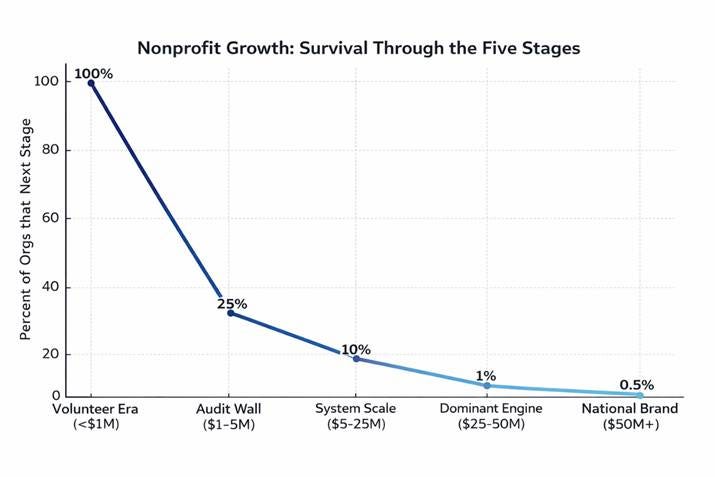
Source: IRS Form 990 data, 2005-2024, via CauseIQ. Combined sample of approximately 56,000 human-services and 14,000 international-focused US nonprofits.
100 percent of organizations start at Stage 1. Only roughly 25 percent ever reach Stage 2. 10 percent reach Stage 3. 1 percent reach Stage 4. Half a percent reach Stage 5.
This is not normal attrition. It is a power law, and a brutal one. The fall-off between every stage is severe, and the severity is not random. Each transition freezes the organisms that refuse to become the next thing. The leaders are trying to grow what should be shed. Killed off.
The five organisms
Five stages. Five different organizations sharing a name. Each one with a job to do, a thing to shed, a fundraising reality, and a kind of leader it needs.
Stage 1. Volunteer Era. Under $1 million.
A founder, a few volunteers, a borrowed room. The work runs on personal conviction and the donor base is the founder’s own contact list. The organism is fast, intimate, and runs on goodwill that nobody is paying for. It can do astonishing things at this size because it has no overhead and no rules. It is also one relationship breakdown away from collapse.
The fundraising reality at this stage is small and personal. The donor pool is the founder’s network, the board’s network, and a handful of small foundations or community grants. Cost-to-raise-a-dollar is technically low because nobody is being paid, but the hidden tax is volunteer fatigue and founder burnout. Paid acquisition is suicide at this size. So is direct mail. So are galas. The math does not work and the cash is not there to absorb the loss.
To become the next organism, this one has to shed the founder-as-everything model, the friends-and-family donor base, and the informal compliance posture that worked when nobody was looking. The leader it needs is one who can build structure while the founder is still in the room, often without humiliating the founder in the process. Most don’t survive this transition. They are not killed by lack of mission or lack of effort. They are killed by the refusal to let the first organism die. The one built entirely around and upon the founder.
Stage 2. Audit Wall. $1 million to $5 million.
Around $2 million, the regulatory environment changes. Full audits. Real HR. State filings. The organism now has obligations it cannot meet with volunteer labor, and the cost of meeting them lands before the revenue that justifies them. This is the most dangerous stretch in the entire sector. Roughly three out of four nonprofits never cross it. Seventy-five percent.
The fundraising reality at this stage is the most punishing in the sector. The channels that work are foundation seed grants, values-aligned family offices, and a low-cost digital sustainer program that can run at roughly ten cents on the dollar once retention is in place. Patient cultivation of a major gift list begins to pay back, with renewal rates near ninety percent once a relationship is established. The channels that kill at this stage are galas, which run cost-to-raise around fifty cents on the dollar and soak working capital, direct mail acquisition, which costs over a dollar to raise a dollar in year one and only breaks even by year two, and rented prospect lists. Most boards push for the wrong channels here because they conflate visibility with revenue.
To become the next organism, this one has to shed the kitchen-table board, the single-channel fundraising model, and the hire-when-you-can-afford-it discipline that feels prudent and is actually fatal. The leader it needs is one who can hold a board through the overhead spike without flinching, who can spend money on infrastructure that will not produce visible results for eighteen months, and who can recruit a fundraiser without being defensive about the cost.
Stage 3. System Scale. $5 million to $25 million.
The organism now has real systems. A CRM that works. A finance team. A development shop. Multiple fundraising channels that each generate enough volume to justify the staff running them. The temptation at this stage is to treat the diversification as the achievement. Look at all our streams. Look at how resilient we are.
The fundraising reality at this stage finally rewards investment. A major gift officer can run cost-to-raise at five to fifteen cents on the dollar with the right prospect list. A scaled digital sustainer program produces stable cash flow once monthly donor retention sits north of fifty percent. Direct mail starts to make sense for the first time, because renewal mail runs around twenty cents on the dollar even when acquisition mail does not. The first serious corporate partnerships become possible at typical check sizes of twenty-five to one hundred thousand dollars. The trap at this stage is not channel selection. It is channel proliferation. Pursuing all of them at once produces overhead growth without revenue growth, and the organization gets stuck.
To become the next organism, this one has to shed the diversification instinct, the all-channels-matter habit, and the regional identity that made the early growth feel possible. The leader it needs is one willing to bet the organization on a single dominant engine and ignore the consultants and board members who will tell them not to. Almost no leader at this stage wants to make that bet, which is why almost none of these organizations cross the next threshold.
Stage 4. Dominant Engine. $25 million to $50 million.
Bridgespan studied every US nonprofit that crossed fifty million dollars in the modern era. Roughly nine in ten of them got there on a single dominant revenue engine that accounts for sixty percent or more of their income. A government contract. A billionaire patron. A flagship corporate partnership. A fee-for-service model at scale. The diversification gospel collapses in the face of the data. Revenue concentration is what scales.
The fundraising reality at this stage is the discipline of the engine. Whatever the dominant stream is, it has its own economics, its own reporting requirements, its own renewal cycle, and its own concentration risk. Government contracts demand a compliance function that will eat roughly nine percent of grant value just to administer. Mega-donor relationships demand a stewardship operation that looks more like wealth management than fundraising. Corporate partnerships at this scale require a dedicated team that can serve the partner’s marketing calendar, not just the nonprofit’s program calendar. The job is to build the depth to actually deliver on the engine, while keeping enough secondary revenue alive to survive the year the engine sputters.
To become this organism, the leader has to shed the comfort of a balanced portfolio and accept the risk of one dominant stream. The leader it needs is one who can manage that concentration risk without becoming hostage to it, who can build the operational depth to actually deliver at this scale, and who can keep the organization disciplined when complexity tries to swallow it.
Stage 5. National Brand. $50 million and up.
At this size, brand gravity does the work that effort used to do. Cost-to-raise-a-dollar can drop below ten cents because fixed costs spread over vast revenue and the organization’s reputation pulls money in without active solicitation. The leader’s job is no longer to find money. It is to steward what now flows, to manage the field-shaping influence the organization wields whether it intends to or not, and to defend against the political and reputational risks that come with visibility at this scale. That is a fundamentally different job, which is why most Stage 4 leaders do not become good Stage 5 leaders.
Stage 5 is also where the internal qualities that won the previous stages stop being decisive. Stages 2 through 4 are won on competence: operational skill, judgment, the ability to recruit and hold a board and read a market. Stage 5 is gated by something else. Sometimes stature, the kind of public name that opens a door before the meeting starts, which is why the IRCs of the world hire former cabinet secretaries and ambassadors. Sometimes embodiment, a leader who reads to peers and donors as a sign of where the sector is going next. Movements have always made their leaps this way, picking leaders who incarnate the direction more than they describe it. There is a symmetry here with Stage 1, which is also externally gated, in that case by the founder’s network and the credibility it lends before the organization has its own. The middle three stages are meritocratic in a way the bookends are not. Most leaders who never make it to Stage 5 fail not because their competence ran out but because they ran out of the other thing.
A personal cut
I ran Alight, a refugee organization, for twelve years. We grew it from $29 million to $70 million, expanded into six new countries, made three strategic acquisitions, founded two social enterprises. By every measure I am supposed to care about, I succeeded there. And by year ten, I knew the organization needed something I was not and did not want to become.
I am an operator. I like doing things. I hate meetings. I hate networking. I hate conferences. I do not join boards. I do not take leadership roles in umbrella organizations. I am highly competitive, which means I have no real interest in helping my competitors. None of those traits are flaws in a Stage 3 or Stage 4 CEO. They are how you get the work done at that scale.
But Alight had reached the stage where it needed someone who would get the invites to Aspen and Skoll and Clinton Global Initiative, who would walk into Interaction gatherings as a peer and a partner rather than a bitter murmurer in the corner. That was not me. Pretending otherwise would have cost the organization the next stage of its life. So I left, and they hired someone who is great at all of it. And it is working.
That is what the metamorphosis looks like from the inside. Not failure. Not burnout. A clean read of what the next organism needs, and an honest answer about whether you are it.
A special note about boards
The same five-stage logic applies to boards, with a twist almost no one names. Each stage of the organization needs a leader fit for that stage. But instead it needs a board fit for the next one.
A Stage 2 organization needs a Stage 2 leader and a Stage 3 board. A Stage 3 organization needs a Stage 3 leader and a Stage 4 board. The board sits one altitude above the organism, and that gap is not a flaw. It is the engine.
By altitude I do not mean wealth. I mean the systems the board members actually operate in. The scale of organizations they run, the boards they sit on, the funder rooms they walk into without an introduction. A Stage 4 board is people who have been Stage 4. They have hired Stage 4 CEOs, served alongside them, navigated Stage 4 crises. They are not guessing what the next organism looks like. They have been it.
That altitude gap is what pulls the organization forward. The board acts as a magnet, drawing the org into the gaps it has not yet filled because the board members can already see those gaps. And when the leader transition arrives, the board does not have to imagine the next CEO from scratch. They are already in rooms with the people who could be that person.
When the gap collapses, the organization stalls. A board at the same stage as the organization stagnates it. The members understand the current problems too well, sympathize with the leader, normalize the constraints. Comfort wins.
When the gap inverts, the organization dies. A board below the organization’s stage kills it. They cannot hold the leader to the next horizon because they cannot see the next horizon. They drag every conversation back to where they are comfortable, which is one stage too small.
The hardest case is Stage 1. The founding board is almost always friends and family who put up the original money. They are a Stage 1 board by definition. The Stage 1 to 2 jump cannot happen until the founder begins replacing them with the kind of people who could form a real Stage 2 board. Most founders never make this swap. The loyalty cost feels too high. Refusing to make it is one of the most common deaths in the sector, and almost no one names it for what it is.
Look at your own board. Not by skills matrix. By altitude. Are they one stage above where you are right now? If they sit at your altitude, you are stagnating. If they sit below it, you are being killed slowly by people who love you. If they sit above it, hold on. They are about to pull you somewhere you cannot yet see.
Close
Nonprofits do not grow. They transform in jumps, repeatedly, under the same name. Each transformation is a death of one organism and the birth of another. The leaders who grow are the ones willing to name the death, including when the thing that needs to die is the version of themselves that built the last stage.
The cliffs in this work are not failures of effort or of mission. They are failures of recognition. We keep trying to grow what should be shed. We keep asking organizations to become bigger versions of themselves, and leaders to become bigger versions of themselves, when what the next stage actually demands is something else entirely.
Read the stage you are in. Read the one that comes next. Be honest about whether you are the organism it needs. The mission deserves that honesty. So do you.