
The Reform We Refused
A response to Randy Flay’s “The Future of Foreign Assistance”

LinkedIn for the past twelve months has been a long procession of people in the development & humanitarian sector all echoing a similar sentence, in various phrasings, all delivered with the kind of weary dignity that is meant to signal both wisdom and grievance.
“Yes, foreign assistance needed reform. But not like this.”
Every time I read it, I want to ask the same question back.
If you knew it needed reform, why did you fight reform for thirty years?
Because we did. Quietly, persistently, professionally, in all the right language. I sat in those rooms. At almost every level.
Randy Flay’s recent Carnegie piece, “The Future of Foreign Assistance,” is the most coherent thing I have read about the 2025 collapse. He treats it not as a budgetary event but as the visible consequence of a long, unmanaged decline in the political consent that underwrote the postwar foreign assistance system. He is right that the debate is posed wrong. Right that the system funds at least seven distinct enterprises that have been defended as one. Right that private philanthropy cannot substitute. Right (kind of) that the work now is to remake rather than restore.
This is not only an American story. ODA fell 23 percent globally in 2025, the largest annual contraction on record. Every major donor cut at once – the U.S., Germany, the UK, France, Japan, the Netherlands. Twenty-six of the thirty-four OECD donor governments reduced aid in the same year. The political weather has shifted in every capital, not just Washington.
But Flay’s piece is written from Washington, with Washington’s politeness, and there is a sharper version of his argument that the sector needs to hear in plainer language.
Here it is.
The public did not abandon the foreign assistance system.
The system became unintelligible while telling itself it was reforming.
A few weeks after the dismantling of USAID, I had a conversation with one of the most senior leaders in the international NGO world. I will not name him. He runs one of the sector’s flagship organizations, and what he told me he was almost certainly telling the executives under him.
The plan, he said, was to retreat into a cave. To hibernate for a year. To not argue with anyone. To operate on whatever funds still came in. To out-survive everyone else. And then, when the field was empty, to emerge and clean up.
I do not tell that story because he is unusually cynical. He is not. I tell it because he is unusually honest.
In one sentence he captured the sector’s actual survival instinct. Not reform. Not public accountability. Not a serious reckoning with why citizens had stopped believing in the enterprise. Survival. Market position. Institutional continuity. Wait out the collapse, let weaker actors die, inherit the ruins.
That is a private-equity consolidation strategy dressed up in humanitarian resignation.
Inside the sector, everyone has always agreed the system must change. Almost no one believes their own organization, program, grant model, staffing structure, compliance process, headquarters culture, or theory of scale should be the thing that changes.
That is the pattern. Reform was always necessary somewhere else.
The funder said implementers needed to be more efficient. The implementer said donor rules made efficiency impossible. The large INGO said localization mattered while preserving the prime relationship. The technical expert said incentives were broken while accepting the next contract to write the next framework. The advocacy coalition said the public needed to understand aid better while continuing to speak in a language designed mainly for insiders.
We had every diagnosis. Easterly. Natsios. Moyo. Lancaster. The MFAN papers. The Paris and Accra and Busan declarations. Two decades of practitioner critique. Some of it overstated. Most of it accurate.
We knew the system was too process-heavy. Too self-referential. Too donor-shaped. Too slow. Too comfortable mistaking compliance for accountability. Too fluent in language that ordinary people could not understand. Too willing to measure what was legible rather than what mattered.
And just too many logos.
We did not lack the diagnosis.
We lacked the institutional intention. And probably the personal courage.
Flay is right to return to Kennedy and Marshall. Foreign assistance once had a public rationale that could be explained in a paragraph. National interest. Security. Prosperity. The prevention of chaos in places whose collapse would cost us more than their stabilization. It connected what happened abroad to what mattered at home. Citizens were being asked to underwrite something whose purpose was legible to them.
Over time, that clarity was replaced by a technical priesthood with all its worship of arcane language and associated rituals.
We built an insider vocabulary. Theories of change. Logframes. Indicators. Localization. Resilience. Inclusion. Systems strengthening. Capacity building. Adaptive management. Political economy. Learning agendas. Some of these are useful. I have used them. I have taught them.
But as a public language, they failed.
The average citizen heard noise. Worse, the average citizen heard evasion. They saw money going out, crises continuing, organizations growing, acronyms multiplying, and explanations becoming more abstract. When the attack came, they did not feel that a duty had been violated. They felt that an invoice had finally been challenged.
That was not a failure of the general public. It was ours. We had spent years talking mainly to each other. With intermittent campaigns about our “obligations” as “richer” nations.
The sector also became poor at distinguishing between defending the mission and defending the machinery. These are not the same thing. Feeding a child, preventing an epidemic, supporting a community after a flood, helping a fragile region avoid collapse, building real partnerships – all of this is defensible. Defending every intermediary, every headquarters cost, every duplicative consortium, every risk-averse procurement habit, every organization that learned to survive without changing – that is not the same as defending the mission.
The tragedy of 2025 is that the attack did not distinguish between the two.
Good work and bad work were hit together. Essential capacity and bureaucratic excess were cut with the same blade. That is what happens when a system refuses to make distinctions internally for long enough. Eventually someone outside the system makes the distinction brutally, ignorantly, and politically.
That is not justice. It is not wisdom. It is not reform.
But it was made possible by our refusal to reform ourselves.
This is where I would push Flay’s argument one step further. He says we need a new policy rationale, new public consent, and a new architecture. He is right. But the architecture cannot be a more disciplined version of the old system with sharper communications. It cannot be USAID restored with better talking points. It cannot be the same implementing ecosystem under a new name.
The world that accepted that ecosystem is gone.
The case for foreign assistance, remade rather than restored, is not the case the sector is currently making on LinkedIn. The case is not “fund us again because the cuts were cruel.” We have always been too focused on process and not outcomes. The case is: the cuts were cruel, and the old system was not good enough. Here is what foreign assistance is for now. Here is what we will stop doing. Here is what we will do differently. Here is how citizens will know whether it is working.
That requires a level of honesty the sector has not yet shown.
I am not certain we will find it. Flay believes we will. I am less sure.
Which brings me back to the LinkedIn sentence I started with.
“Yes, reform was needed. But not like this.”
The sentence sounds reasonable. It is even partly true. The way the cuts came was destructive. It dismantled capability that will not be easily rebuilt. It treated people as disposable. It hit clinics and food and medicines and trust and lives.
But the sentence also hides something.
We deserved what happened. But the poor did not.
It allows us to acknowledge the need for change in principle while never having to answer the harder question. If we knew reform was needed, what stopped us from doing it when there was still time?
The honest answer is that we did not want to be the part that changed.
We wanted reform to happen to other parts of the sector. We wanted reform to happen on a timeline our boards could absorb. We wanted reform that did not threaten our own roles, our own salaries, our own brand positioning, our own access to funding cycles, our own seat at the convening table.
That is what was refused. Not reform as an idea. Reform as a thing that costs us something.
The 2025 collapse was not only an attack.
It was a verdict.
Not on the worth of the people served. Not on the courage of field staff. Not on the moral importance of the work. On the failure of an institutional system to renew its purpose, explain itself honestly, and change before change was imposed.
We should oppose vandalism.
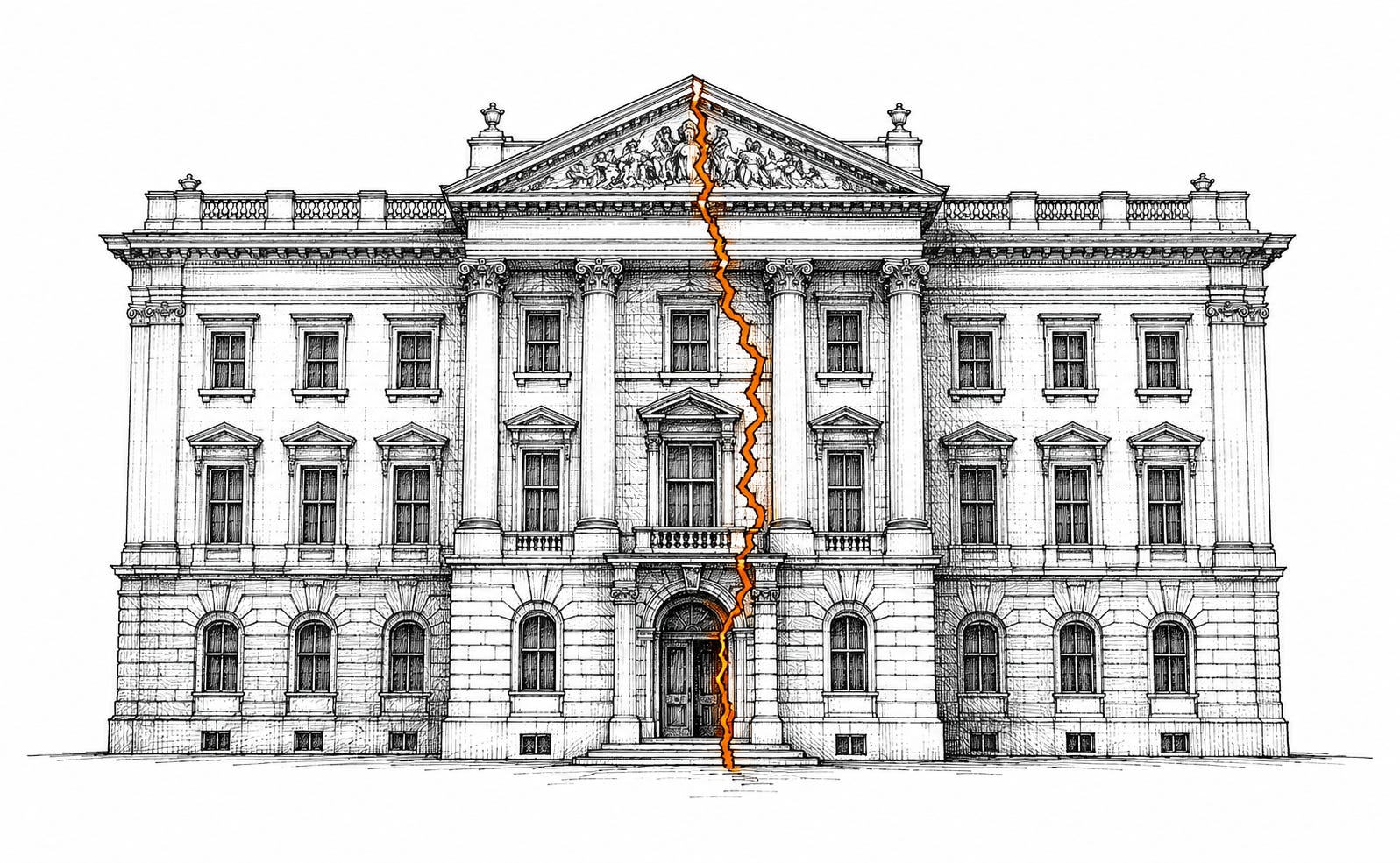
But we should not confuse opposition to vandalism with nostalgia for the building.
The building had been cracking for thirty years. Many of us saw the cracks. Many of us said so privately, after the meetings, on the planes home. Some said so publicly. Some said so loudly enough that it cost them their jobs.
But the sector as a whole acted as if the warnings applied to someone else.
That is the reform we refused.
If foreign assistance is to have a future, that refusal has to end. The cuts were cruel. The old system was not good enough. Both can be true. Until we can say both, the case we make will not be believed.
"All truth passes through three stages. First, it is ridiculed. Second, it is violently opposed. Third, it is accepted as being self-evident." - Arthur Schopenhauer
Thank you for this brilliant piece. As a development economist with 25 yrs working in the aid machine I have cited all the greats Easterly, Moyo, O Hirschman et al and been personally attacked and threatened by the Lords of Poverty. I no longer believe these people have any productive part to play in Aid 2.0… i look to support brilliant Global Majority expertise.