
The Ten Year Winter
The good news and the bad news

Summary: We are not just in a funding dip. We are at the start of a decade-long transition between architectures. The old architecture is dying. The new one will be assembled around shocks. The serious work now is to build the capabilities before the shocks arrive.
Let’s start with the bad news…
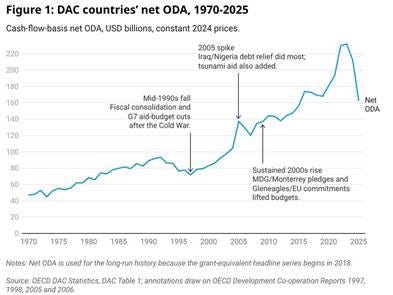
Source: Robin Davies, Devpolicy Blog, drawing on OECD DAC Statistics.
This is the graph Robin Davies at the Devpolicy Blog recently published. I produced a very similar one in the first week of the USAID collapse in early 2025. My point to the organization I was in was simple: brace yourselves. The impact will be measured in ten years, not ten months.
The thinking has not changed. The numbers are now confirming it.
Real ODA fell from $232 billion in 2023 to $163 billion in 2025. A 30 percent real decline in two years. Larger than any contraction in the history of the system. Davies has done rigorous accounting of where this goes next. His central projection has another 30 to 50 percent fall over the next three years. By 2028, aid from OECD sources could sit at levels not seen since the late 1990s.
That is the data.
The harder question is what it means.
Here is what I think it means. We are not at the bottom. We are at the start of a long lean period. The system that defined foreign assistance for the last twenty-five years is finished. The system that will replace it does not exist yet. Between now and then is a decade in which most conversations about the future of foreign assistance will be wrong, and we will not know which ones until much later.
I know this because I have lived through one of these before.
I started in this work in 1995. The Cold War had ended. Real ODA had fallen 15 percent in 1990 in a single year, the largest contraction the system had ever seen at the time. The decline kept going. The real trough did not arrive until 1997. From the outside that looks like a ten year flatline. From the inside it was the period when the assumptions that had defined the previous era quietly came apart.
I do not remember it feeling like anything in particular.
That is the point.
David Foster Wallace told a story about two young fish swimming along. An older fish passes them going the other way and says, morning boys, how’s the water? The two young fish swim on for a while. Eventually one looks over at the other and says, what the hell is water?
That is most of what I want to say about the 1990s.
I was not watching a paradigm shift. I was inside a set of assumptions that defined what foreign assistance was, and I could not see them because they were the water.
Some of those assumptions are worth naming, because they are gone now and nobody talks about how completely they are gone.
In 1995, International Non-Government Organizations, the CAREs, Save the Childrens and others, were still a sideline. The do-gooders in sandals and t-shirts. Useful around the edges. Occasionally photogenic. Not a serious instrument of bilateral policy. DANIDA’s 1996 evaluation of whether INGOs could be a legitimate channel for ODA was treated as a surprising finding at the time. I wrote a graduate school essay using it as the anchor. The conclusion, yes, INGOs can be a legitimate channel, set off a decade of restructuring. By 2010 the INGO-as-contractor architecture was the dominant feature of the system. By 2025 it is the thing being dismantled. Nobody is asking the question DANIDA asked anymore. The question itself has disappeared.
In 1995, humanitarian work was also a sideline. The real game was development. Long-arc work on growth, governance, institutions. Humanitarian was what you did when things blew up unexpectedly. Today humanitarian work is more than half of OECD ODA. Development as a coherent field has been hollowed out. That reversal happened so gradually that almost nobody named the moment it happened. For reference, the UNDP was royalty in the 90s and 2000s. Today it’s UNOCHA, and no one knows what UNDP does.
In 1995, the central lever was Structural Adjustment. The IMF and the World Bank, with bilateral support, restructuring economies in exchange for finance. It was the policy argument of the decade. Anyone under forty in the sector today has never lived through a live Structural Adjustment debate. To them it is something from a history book. To me it was the air in the room.
Three assumptions. Three complete reversals. None predicted at the time. All obvious in retrospect.
And the conversations we all had? Poverty as lived experience. The World Bank’s Participatory Assessments. Chambers and IDS. Poverty as social development. The UNDP’s HDI. Development as a Rights-Based Approach (Häusermann, DFID). Debt relief and Jubilee. Development as targets. The DAC goals. Then the MDGs.
The victor? The MDGs.
Or was it the Global War on Terror, which appeared almost exactly a year after the MDGs were released?
I am not telling you this because I want to relive 1995. I am telling you this because the assumptions defining the work today are also water. The next decade is going to reveal them the way the last decade revealed Structural Adjustment.
Brace yourselves. We are in for a ten year winter. Some names will still be on the buildings. The architecture inside will not look much like what we have now.
So what shapes what comes next?
Not us. Not our meetings. Not our convenings at Aspen or Bellagio. Not the white papers in SSIR. The conversations of the next decade about the future of foreign assistance that actually matter will not happen at any conference most of us attend.
They will happen because something in the world makes them necessary.
Look back at the period I described above. The 1990s were full of suffering that should have moved budgets and did not. Rwanda. Bosnia. Somalia. The Asian financial crisis. Central American civil wars. The narcotics wars in Colombia. Suffering at unimaginable scale. Nothing moved the budget.
What moved it was a single morning in New York in September 2001.
That is uncomfortable to say. It is also what the graph shows. Step-change increases in funding for foreign engagement do not come from suffering elsewhere, however acute. They come from events that reach the donor public directly. The MDGs gave the senator the language. 9/11 gave her the constituency. Without 9/11, the MDGs are a footnote in development studies.
We are not the ones who decide. We respond. We provide a vocabulary politicians can use when the moment arrives. We are useful when the moment arrives and largely irrelevant when it does not. At least as it relates to ODA.
This is uncomfortable for the sector because it puts us where we have always been but rarely admit.
Now consider where we are right now.
USAID was effectively dismantled in early 2025. Most of its programming stopped. Hundreds of contracts ended. Tens of thousands of people lost their jobs. The implementation architecture built over twenty-five years was unwound in months.
It has been a year now.
A reasonable expectation, if foreign assistance had been doing what we said it was doing, would be that the impact on the populations we served would now be clearly visible. Demonstrably. With numbers. In ways that move political opinion.
It hasn’t happened.
The sector has tried. Reports. Op-eds. Congressional briefings. Modelling exercises. Mortality projections. None have moved the political needle. The Trump administration has not reversed course. Bipartisan support has not coalesced. Donor publics in other countries are not more agitated. The political weather is not shifting.
Why?
Here is one possible answer, and it is harder to swallow than the sector wants to admit.
Roughly three-quarters of US ODA was being consumed inside the Western aid system itself. Implementing partners. Sub-contractors. Headquarters costs. The intermediary layers funding passed through before reaching anyone in the country it was nominally for. When USAID disappeared, what disappeared most visibly was that infrastructure. Western organizations losing contracts. American workers losing salaries. Sub-committees no longer convening. And a complete collapse of white papers.
The impact on the populations the system was supposed to serve is real. But it is smaller, slower to surface, and harder to measure than the impact on us.
I am not saying foreign assistance does no good. It does. I have spent thirty years doing this work because I believe it does good. But the proportion of each dollar that actually reached a person in a fragile place was always smaller than the sector’s narrative claimed. Now that the system has been broken, the gap between what we thought we were doing and what we were actually doing is becoming visible.
There is a second piece of evidence pointing the same direction.
The localization conversation of the last decade was supposed to fix exactly this. It was the sector’s own “attempt” to shift money, position, and decision-making to local actors. Every major donor signed on. Every major INGO committed publicly. Conferences were held. Frameworks were issued. Pilots were funded.
Ten years on, almost nothing has shifted.
The clearest recent example was laid out by the consultant Nihad S. The Syria Humanitarian Fund made a $146 million reserve allocation this year. Year fifteen of the Syrian crisis. The allocation went to 17 international actors, a mix of UN agencies and large INGOs. Not a single Syrian organization was a direct recipient. This in a context where Syrian civil society has been delivering at scale for fifteen years. They were the only ones able to. Where alternative models work, the Aid Fund for Northern Syria channeled 75 percent of its funding directly to Syrian NGOs in 2023.
The pattern repeats across the sector. The most interesting case is the one where someone is actually trying.
In December 2025, Save the Children International announced it would progressively withdraw from UN OCHA Country-Based Pooled Funds by the end of 2027. A principled move. Save publicly called on other large INGOs to follow, warning that the withdrawal would be “meaningless” if they simply filled the gap.
By April 2026, The New Humanitarian was reporting that Save was still in line to receive substantial pooled fund money: $850,000 in Kenya, $10 million in Myanmar, around $20 million more across Sudan, Mozambique, Nigeria, and South Sudan. The withdrawal, Save says, is phased. Standard allocations by end of 2026. Reserve allocations by end of 2027.
No other major INGO has matched the pledge.
Meanwhile, in those same early-2026 allocations, almost nothing reached local organizations directly. In Kenya, just 2.1 percent. In Myanmar, nothing at all.
The first-moving actor in the sector is in an uncomfortable middle. The rest are not even pretending. The system continues.
This is not a problem of philosophy. It is a problem of incentive. Large organizations, asked to give up the funding flows that define them, do not give them up. They reorganize. Restate. Rebrand. Restructure. The dollars do not move.
If they would not divest in ten years of stated commitment to localization, with donor pressure behind it, they are not going to divest in the next decade while fighting for survival. The architecture they propose for the future will be the architecture that preserves them. And the architecture that preserves them is the architecture that just failed.
I am not saying large INGOs should not exist. Oh lips hold thy seal. I am saying the conversation about what comes next cannot be led by them. They will be in the rooms. They will publish reports. They will be quoted. But their architecture proposals will be filtered through their own survival, and that filter cannot produce what the next era requires.
Anyone serious about what comes next has to be willing to do that work either alongside or, where necessary, without them.
So if not our meetings, and not our existing institutions, what?
Events.
Not Davos. Not Aspen. Destabilizing events that hit donor publics directly and make political moments inevitable. We cannot predict which specific events. We can predict the categories. They are knowable. They are bounded. They are coming.
So what do those events look like?
Here is the part that gives me some confidence even in the middle of a winter. We cannot predict who shapes the next era. We can predict, with reasonable accuracy, what will shape them.
The forces that will move money and assemble actors over the next decade are not unknowable. They are bounded by physics, biology, and economics, not by politics or worldview. They have hit donor publics before. They are hitting them now. They will hit them again, with rising frequency.
There are roughly six categories.
Disasters and shocks – Wars, civil strife, earthquakes, hurricanes, infrastructure failures. Natural and engineered. Always with cascading collapses behind them.
Epidemics and health crises – Ebola, cholera, influenza, HIV, SARS, COVID-next. Frequent and frightening, with a big one within the decade. The next one is not a question of whether. Only what.
Food insecurity and price volatility – The 1973 oil shock. The 2008 food crisis. The 2022 grain crisis. Different commodities, same category. Donor publics feel it through inflation.
Mass movement of people across borders – A trigger category since the Irish famine. Conflict, climate, and collapse keep producing it. Think one million refugees into Germany in one year, as happened in 2015. Origins change. Category does not.
Economic and currency contagion – The 1997 Asian crisis. The 2008 global financial crisis. Sovereign-debt events large enough to threaten donor-economy stability. 1.3 billion young people entering the labor market within ten years. Large-scale joblessness baked in.
Climate at scale – The newest as a discrete category. The recurrence rate is now rising fast enough to be reliable. Coastal flooding. Multi-breadbasket failures. Fire seasons reaching into developed economies.
These are the forces. Each one is familiar. None is new.
What is new is what they will be hitting.
We are living in a world prepared for the opposite of the moment we are now in. The post-millennium architecture assumed integration. Just-in-time supply chains across twelve countries. Banking systems clearing in seconds across borders. Trade flows, capital flows, information flows, all moving faster and further than the institutions that used to slow them down.
The result is a world where what happens in one place arrives somewhere else almost immediately. A war in Ukraine shows up on a Lagos market shelf within weeks. A virus in Wuhan reaches Milan in a month. Climate-driven migration becomes a political event in donor capitals within a news cycle.
The political and institutional layer is doing the opposite.
Multilateralism is in retreat. The WTO is paralyzed. The UN system is being defunded. The G7 and G20 cannot coordinate even rhetorically on issues that require coordination. The countries that built the postwar institutions are turning against them.
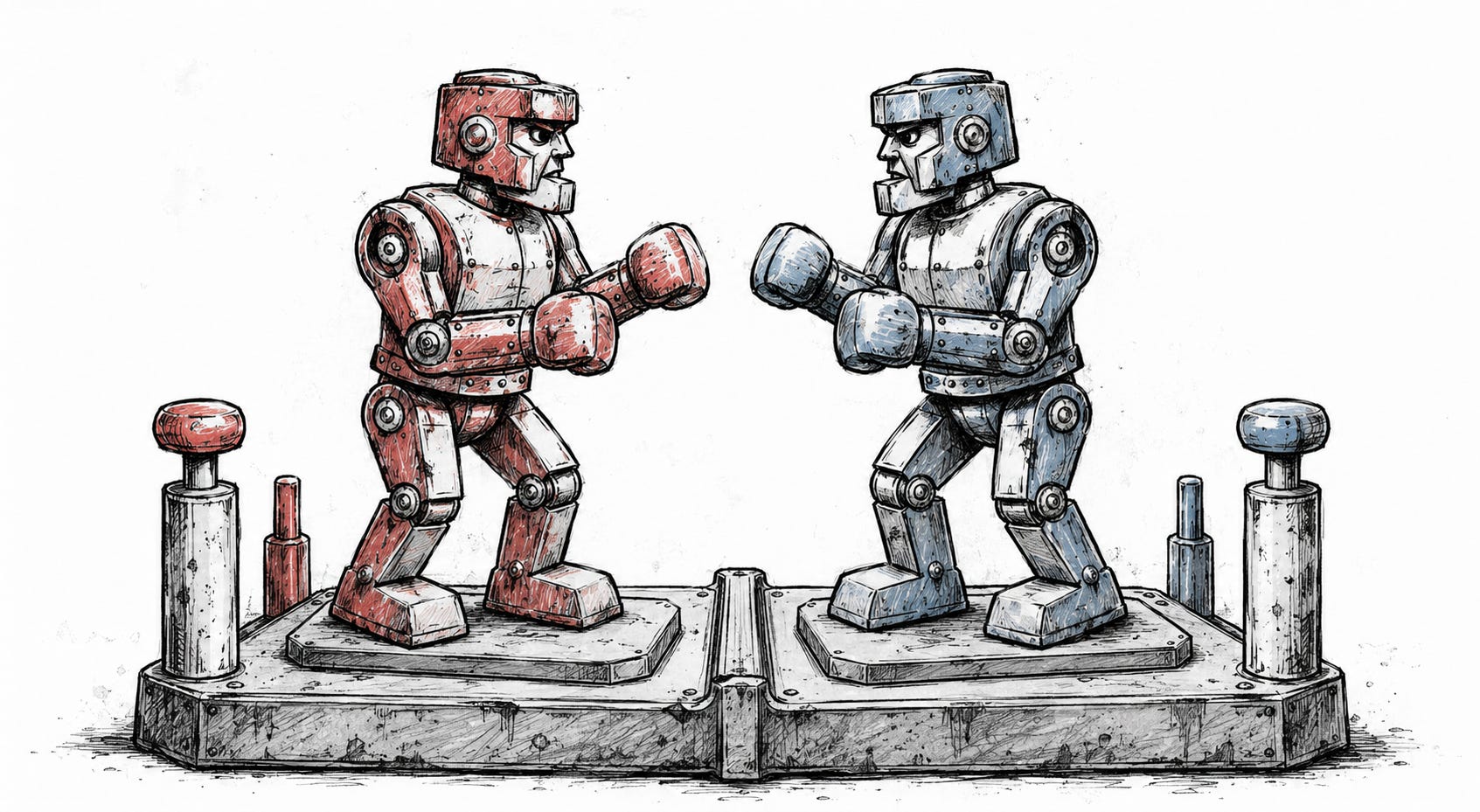
This is the gap. We are like that “Rock Em Sock Em” plastic toy that has two robots, joined together at the base while vigorously fighting each other with its fists. Our systems are entwined while our leaders act unilaterally as if we are separate. The integration is real and the fracture is real. Both happening at the same time, in the same world, between the same actors.
The Iranian strike and the closure of the Strait of Hormuz was the small, current version. A unilateral action in a deeply multilateral system. The action takes hours. The consequences move through oil markets, shipping insurance, currency flows, and food import chains in days. The political logic is sovereign. The economic logic is global. The two now contradict each other.
Now imagine that pattern across all six force categories. A pandemic when multilateral health coordination has collapsed. A food crisis when grain corridors are blocked. A migration wave when receiving countries have closed legal pathways but still depend on the labor that movement provides. A climate event whose response requires coordination between governments that no longer trust each other.
Each category alone is hard. The cascade is harder. The cascade in a world that has lost its coordination infrastructure is something the system has not seen before.
That is what the next decade is going to test.
If we cannot predict the actors but can predict the forces, we can also specify the capabilities the response will require. The architecture is for whoever builds it. The capabilities are knowable now.
There are six.
A shock response and logistics capability – Cash, air bridges, pre-positioned stocks. The infrastructure to move resources fast when the trigger arrives. In a world where shipping lanes are contested, where some passports get through and others do not, where the relief routes that worked five years ago cannot be assumed to work tomorrow.
A global health and epidemics capability – Surveillance networks, surge teams, vaccine cold chains. The infrastructure to detect and contain before disease crosses into donor populations. In a world where WHO has lost the authority to coordinate, where countries hoard vaccines and data, where the cooperation that made early COVID response possible is gone.
A food systems and market stability capability – Grain corridor insurance, fertilizer swaps, financial instruments to hold regional food economies together through shocks. In a world where trade routes are weaponized, strategic stockpiles are political, and bilateral deals replace multilateral rules.
A migration and human mobility capability – Safe return corridors, labor mobility pilots, architectures that absorb pressure before it reaches donor borders at unmanageable scale. In a world where legal pathways are closing, where receiving countries have turned hostile to movement, but their economies still depend on the labor that movement provides.
A risk finance and private capital capability – Guarantee windows, catastrophe-bond facilities, the instruments that let private capital absorb shocks the public sector cannot underwrite alone. In a world where sovereign credit ratings are more volatile, where private insurers are quietly exiting climate-exposed geographies, where the public-sector backstops of the last era cannot themselves be backstopped.
A communication and information capability – Reliable, real-time, usable information. The infrastructure to make sure the people who have to act know what is actually happening. In a world where official channels are politicized or absent, where AI-generated content has eroded the trust public information used to depend on, where every crisis now arrives wrapped in a parallel information war.
These six capabilities map onto the six forces. They are the work the next decade will demand. They will get built somewhere. The question is whether they exist at adequate scale, and in the right shape, when the trigger events come.
Some of you will tsk, tsk me and say I framed this too negatively. Why didn’t I use positive phrases like wellbeing, peacebuilding, and capability strengthening which are more motivating?
For the exact reason that they do not motivate more and never have.
That is my basic point.
The work of this decade is not to design the new framework. It is to make sure the capabilities exist somewhere, in some form, so that when the moment arrives there is something for the new actors to assemble.
That is the work I am trying to do. That is the work I think a small number of others are also trying to do. The rest of the conversation is mostly noise.
We are in for a ten year winter. The temperature is going to drop further before it stabilizes. The thaw, when it comes, will not look like restoration. It will look like the arrival of something new, assembled by people we cannot name, in response to forces we can.
The work of right now is to be ready.
And the good news? Well, we are already through year one.
I think the statement "A reasonable expectation, if foreign assistance had been doing what we said it was doing, would be that the impact on the populations we served would now be clearly visible... In ways that move political opinion" is off base. The impact is very clear and has been well documented. As you point out earlier in the piece, the real reason political opinion hasn't been moved is that the American people don't care about foreign aid's impact abroad, and they don't care about the negative consequences of its cancellation. People don't even care about the millions of people facing famine due to the closure of the strait of Hormuz. I think you are correct in your earlier statement that nothing will move public opinion on this until the American public is directly impacted. Ebola might be that trigger, but I'm not holding my breath.
I also want to add some nuance to the often-highlighted reliance of the US foreign assistance apparatus on US-based implementing partners, or as you put it 'that Roughly three quarters of US ODA was being consumed inside the Western aid system itself‘. I'm sure you are well aware, but for your readers: Yes, most holders of the prime contracts and cooperative agreements for US ODA were American companies or organizations. But in most cases these companies implement these programs by hiring a bunch of local people in the country in question, and also issue a bunch of subawards. These can also go to international organizations but often are issued to local actors. USAID regularly required a substantial portion of program budgets to be set aside for subawards - in some cases, up to 50% or even 80%. Similarly, portions of the budget usually go to both local and international short-term consultants recruited externally to do specific pieces of the scope.
So while it's true that the prime implementers get the contract, bill their US-based employees to the project, and also get to collect indirect costs, this system also channeled lots of money into local employee salaries, consultant incomes, and local organization budgets. Is that the ideal system? Definitely not, but it's the one that developed in response to the US government's lack of in-house program management and technical expertise to manage these programs directly, and the lack of capacity of most local organizations to navigate the US government's complicated procurement processes or comply with the intensive financial management and reporting requirements that the US government imposes on implementing partners. I'm not sure how much true localization was ever going to be an option given those constraints.
Raj Patel's paper, "The Long Green Revolution," situates ODA in its historical context. This was always a geopolitical project that changed with shifts in the Great Powers and with national political settings. Remember that the International Red Cross and Red Crescent Movement and Oxfam both emerged from Great Power struggles.